
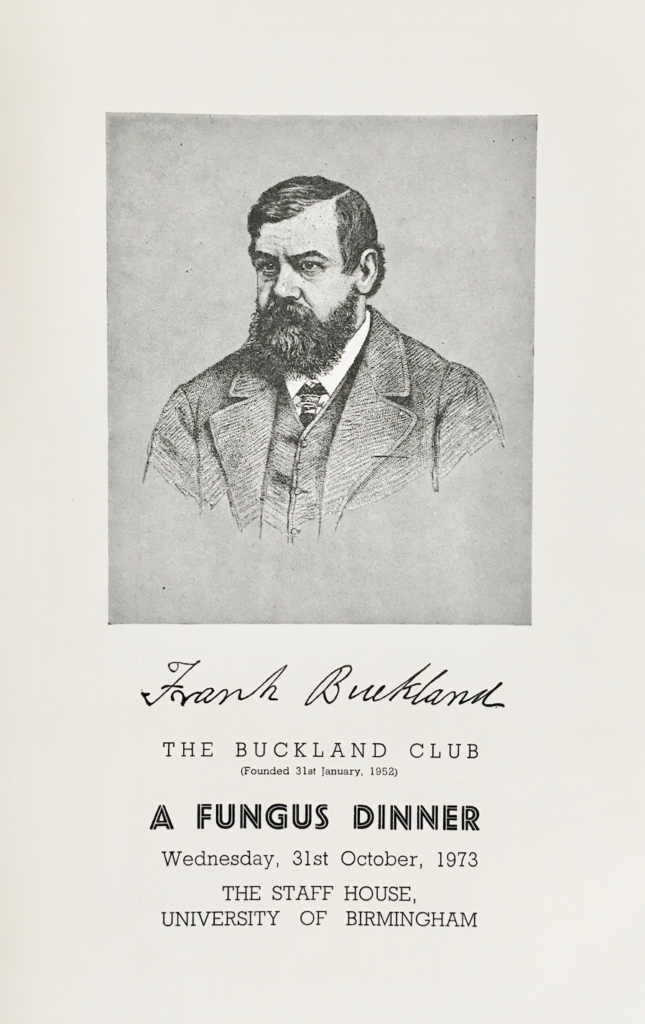
Date: Wednesday 31st October 1973
Venue: Staff House,
University of Birmingham
Sponsor: Dr A.C. Houghton
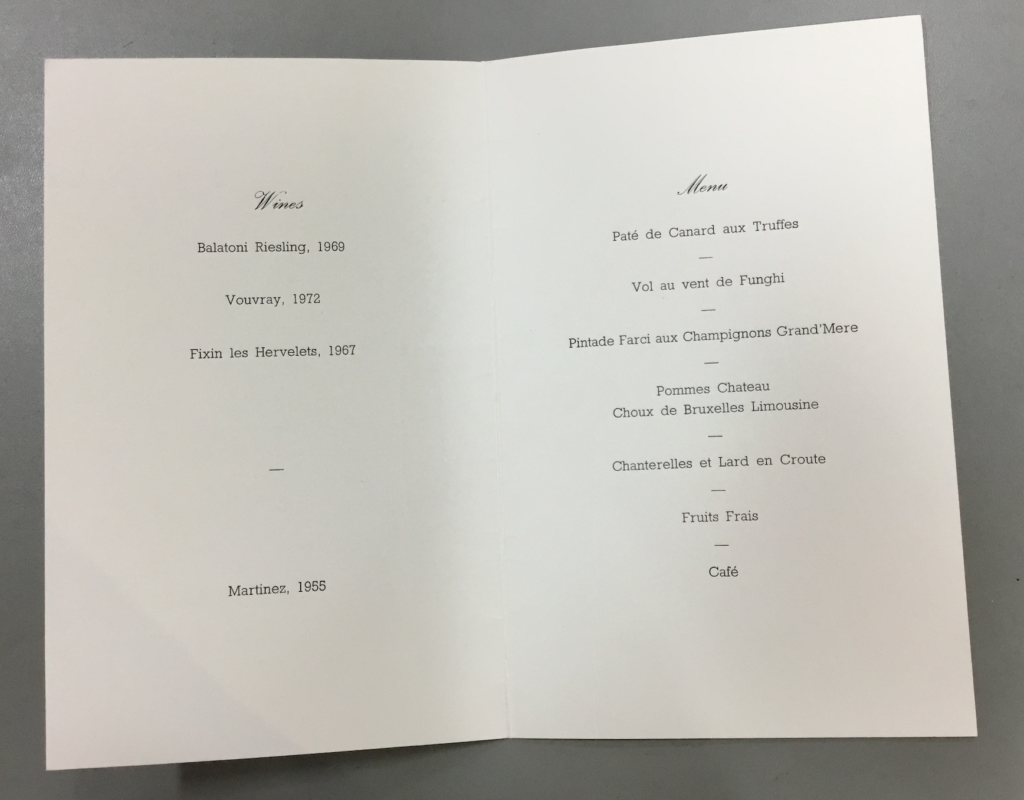
Menu
At…”a Fungus Dinner, where each course featured a different fungus. Our Guest of Honour, an eminent pharmacologist, quipped that he may have been invited to ensure we didn’t poison ourselves. We didn’t – and he was probably right!”
Committee member Christopher Firmstone recalls the notorious Fungus Dinner.
Minutes of the Fungus Dinner
A FUNGUS DINNER
31 October 1973
The Dinner was held at the Staff House of the University of Birmingham on 31 October, 1973. Our sponsor was our member and friend, Dr. A.C. Houghton.
Before dinner we drank white wine, a Balatonier Riesling. Our sponsor reminded us that our debt to fungi had already begun. Yeast is a fungus and without it we would of course have no wine. Some found it a little sweet to drink alone.
We then ate an excellent duck pâté aux truffes. It was made from duck, duck’s liver, truffles (two tins at £3.50 each) and brandy. We had begun with gastronomy’s most illustrious fungus and some of the more nervous members began to relax a little. With it we drank Vouvray. This was also rather sweet, but the tradition of a sweetish wine with pâté is a very old one and ought not to be despised.
Our sponsor had by now begun to give us a charming chapter of autobiography to explain his introduction to the subject of our dinner. It seems that in a moment of exuberance after finding that he had passed a pathology examination, he picked up a pretty girl who was also reading the results. In due course he married her. She is the expert on fungus. She had a Russian grandmother who brought her up in Sweden during the first world war. Her grandmother taught her to identify, cook and appreciate the many fungi that are to be found all around us, but which most of us treat with dislike and fear. Learn young, learn well.
We then came to a dish which contained a great variety of fungi. Our sponsor told us that there were ten different varieties but he listed them with such erudition in so many different languages that it seemed many more. The difficulty is that some of them do not have English names. I have, with the sponsor’s help, listed the fungi we ate during the dinner with their names in various languages as an appendix to these minutes. In making the list it came to light that there were considerably more than ten. The contents of the vol-au-vent were fascinating in taste and texture. They had been prepared by the sponsor’s wife. The vol-au-vent case however which had been made by the Staff House kitchen was somewhat less satisfactory. Some called it dry, hard and tasteless.
When we had enjoyed such a variety of interesting and delicious fungi, the sponsor asked why it was that in England the only one normally eaten was the field mushroom. Robert Graves thought that the reason may have been originally religious. There was certainly a connection between fungi and the mysteries of Eleusis, but that did not seem to explain why the Slavs eat a wide selection, the Germans and the French several, while we only eat one. It seems a pity.
The sponsor also quoted Robert Graves on the subject of Fly Agaric. Apparently it gives a good strong trip – sometimes agreeable and sometimes the reverse. The Norsemen ate it before going into battle. Today it is eaten by reindeer when it grows on the tundra. The Lapps it seems sometimes consume it at second hand in the form of reindeer urine. The club was relieved to know that Fly Agaric was not on the menu in any form.
The next course came from the Dordogne – guinea fowl stuffed with mushrooms and butter to keep it moist. It was accompanied by chestnuts and brussel sprouts and was very good. With it we drank a wine in which the yeast, assisted by the inhabitants of Burgundy, had done its work particularly well. The wine was a Fixin Les Hervelets 1967.
We then came to what was perhaps the most delicious course of the whole evening Chanterelles or Pfifferlinge fried in butter with a little bacon and onion. They had been picked in a pine wood and dried by the sponsor himself. We liked them very much.
Finally, we ate fresh fruit which could perhaps be described as only marginally fungoid. There was a bloom on the skin of the grapes. On this basis every course and our drink contained fungus. We consumed 18 varieties*.
Our debt to the sponsor and his wife was not yet complete his wife had charmed Mr Reynolds of the staff house into producing a special port for us. It was Martinez 1955 and very good it was.
The chairman thanked the sponsor and told the Club how happy he felt after the dinner. He hoped that we would all feel equally happy on the morrow. He then introduced the club’s guest the Professor of Botany at Birmingham University, Professor J.G. Hawkes.
The Professor in thanking Houghton and his wife told us that he was not sure whether he had really been invited as a kind of insurance policy to confirm the wholesomeness of what we were eating. If this were the case, he regretted that it had failed as he was quite unable to recognise the fungi after they were cooked. He was however only “a potato man” whether professionally or gastronomically we did not learn, but he felt that the potato was too boring a subject for a Club dinner. Some of us wondered.
So ended an evening of great interest and pleasure. Houghton and no doubt his wife made us feel something rather rare at a dinner of such a size in a public place. Our food had been prepared with love.
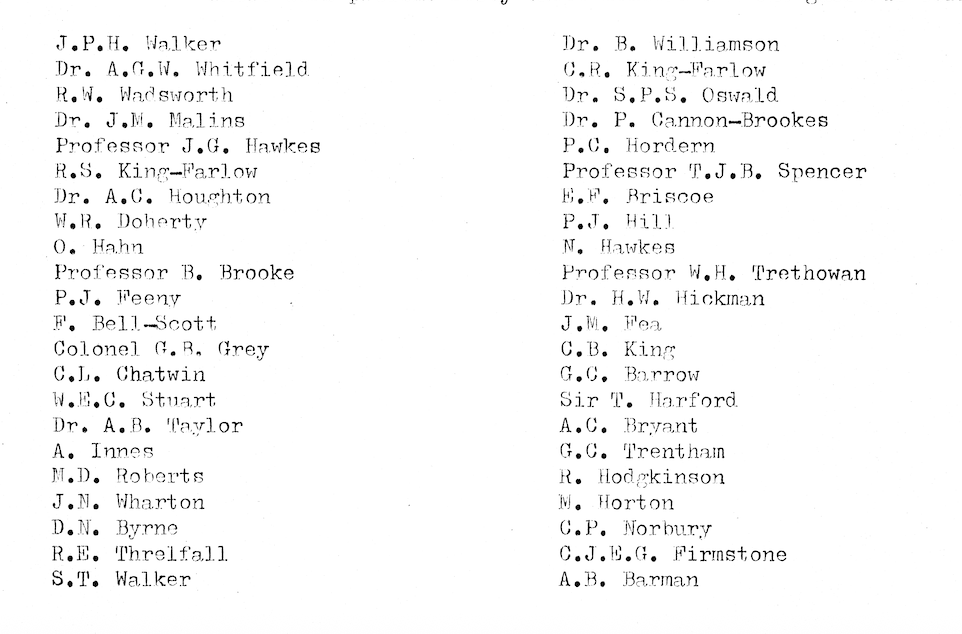
There were present 43 members and one guest.
-
Fungi consumed at the dinner